Author:
Susan McDonough
Author: Susan McDonough
8 March 2026
The missions were complex enterprises. Acting more or less autonomously, the priests valued aesthetics and trained the Native Americans in the region to create religious art and decorate the churches and their related secular buildings. In addition, numerous expedition artists continued to make sketches and drawings for government surveys. In keeping with the interests of the day, depictions of flora and fauna were popular subjects. Renderings of the indigenous peoples and their culture were not—primarily because the Spanish, through disease and forced assimilation, stamped out the majority of the native population relatively quickly. There are many jokes made about California’s “lack of culture,” but in this terrible instance, it proved to be true to an alarming degree, and artists traveling on scientific and surveying expeditions focused on the landscape, its plant forms, and its wildlife.
After Mexico gained independence in 1810, Alta California was officially annexed 12 years later. Mexico secularized the missions in 1832, which led to their abandonment. What arose in their place was a landed aristocracy of native Californios or rancheros, whose total population hovered around 12,000. Overall, the rancheros favored architecture and the decorative arts over easel painting, very little of which remains from this early period. Traveling artists such as Ferdinand Deppe and Richard Beechey continued to arrive, primarily by ship, and their efforts provide valuable documentation of life in the ports and garrisons.
January 1848 is the date that really matters when talking about California art history. For it was then that gold was discovered at Sutter’s Mill in Coloma, California, in the foothills of the Sierra Mountains. At that point, modern day California was born. From 1848 to 1852, the population of non-Native Americans in the state increased from approximately 14,000 to 223,856. Meanwhile, the United States, which had wrested control of the area from Mexico in 1848, quickly admitted the region to the Union in 1850. While the Gold Rush was effectively over by 1852, these new settlers, known as Argonauts, had transformed the area from a sleepy colonial backwater to a rapidly industrializing state with its own aristocracy and bourgeoisie, and with a group of artists ready to serve them.
Out went the Californio lifestyle and in came European trends and modes of living, which meant portraits, genre scenes, and large history paintings. These prominent early Gold Rush artists included the Nahl brothers, Charles Christian and Hugo Albert, as well as Albertus Del Orient Browere and Ernest Narjot. Major patrons included the Big 4 railroad barons—Charles Crocker, Collis P. Huntington, Mark Hopkins, and Leland Stanford. It should be noted that this scramble by the new rich to document their place in society was a Northern California phenomenon. A professional artistic class did not emerge in southern California until much later in the century after the railroads arrived.
During this rush to decorate mansions and country estates, there was a parallel movement happening: landscape painting in the Yosemite River valley. San Francisco’s nouveau riche as well as the state’s isolation from the Civil War made Yosemite an attractive destination for traveling artists. Yosemite had been “discovered” in 1851 when the U.S. Army entered the valley in pursuit of the Ahwaneechee, the native people who had lived in the valley for centuries. Tales of incredible beauty brought forth a rash of explorers soon thereafter. In 1855, the San Francisco-based artist Thomas Ayres was hired by local publisher James Mason Hutchings to draw what are today considered to be the first images of the valley and were later turned into a series of prints that were widely distributed and exhibited in New York. These and other images of the Yosemite brought about a dramatic increase in tourism to the area between 1855 and 1860.
The valley became a major pilgrimage for artists in California and from across the country. Painters such as Thomas Hill, Virgil Williams, Enoch Wood Perry, William Keith, Albert Bierstadt, Thomas Moran, and Herman Herzog captured Inspiration Point, Bridal Veil Falls, El Capitan, Half Dome, and other famous vistas. Similar to much of American landscape painting during this period, there is a reverence and religiosity that imbues these works.
By the 1880s, painters who had been studying in Munich and Paris, such as Arthur F. Mathews, began to arrive in the state, bringing with them all that they had learned abroad. Barbizon, Tonalism, Impressionism, and Post-Impressionism all took root, more or less around the same time, and in many cases were practiced simultaneously. As Director of San Francisco’s Califoria School of Design from 1890–1906, Mathews had a profound role in the adoption of Tonalism as the reigning style. He and his wife and partner, Lucia K. Mathews would later become celebrated for their elaborate carved and polychromed furniture and decorative objects, done in what is now known as the California Decorative Style.
Tonalism, with its misty atmospheres and subdued palettes, was, as anyone who has enjoyed a foggy summer day in San Francisco can tell you, perfect for depicting Northern California’s coastal climes. This artistic style dominated landscape painting in Northern California from the 1880s up until the second half of the 1910s. Much of the activity took place on the Monterey peninsula, an area that includes the towns of Carmel, Monterey, Pacific Grove, and Santa Cruz. The artists who congregated there, led by painter and Bohemian Club founder Jules Tavernier, became known as the Monterey Colony (active during the late 1870s to 1930). The Colony’s leading practitioners included Martinez, Giuseppe Cadenasso, Piazzoni, E. Charlton Fortune, Evelyn McCormick, and later the watercolorist Percy Gray. Windswept sand dunes, Monterey pines and cypresses, foggy valleys, and misty groves were very popular subjects.
Despite Tonalism’s reign, it is Impressionism that is most often associated with California painting. It arrived late to the state; and reached its apogee in Southern California in the early part of the twentieth century, long after it had come and gone in France. California, with its abundant natural beauty, brilliant light, and temperate weather, is tailor-made for Impressionism, especially as it relates to landscape and plein-air painting.
In the 1890s, California painters such as Evelyn McCormick, and Guy Rose spent time in Giverny, France. The state’s first exhibits of French Impressionist works took place in the early 1890s and showcased paintings by Monet, Renoir, Degas, Sisley, and Pissarro that were mostly drawn from private collections in San Francisco. By then, Northern California painters were beginning to experiment with the Impressionist style. However, Tonalism continued to hold sway, and California Impressionism was often melded with one or two differing styles and techniques.
The Impressionist style rapidly picked up steam in Southern California at the turn of the century. William Wendt, Granville Redmond, and Maurice Braun (all painting with Tonalist overtones) were among the earliest practitioners. Meanwhile, the California Art Club in Los Angeles became an important locale for exhibiting artists and started to promote the style. In Pasadena, Franz Bischoff, Benjamin Brown, Marion Kavanaugh Wachtel, and Elmer Wachtel were capturing the motifs that were to become central to California Impressionism—poppies, lupine, eucalyptus, and roses. The Arroyo Seco, a dry creek that extended from Los Angeles to Pasadena, was a sacred subject for these artists just as Yosemite had been 25 years earlier. In 1914, Guy Rose settled in Pasadena, a timely harbinger that Impressionism would dominate the California scene within a year.
In 1915, San Francisco was ready to announce its rebirth after the 1906 earthquake and fire, with the completion of the Panama Canal as its nominal cause for celebration. The result was the Pan-Pacific International Exposition (PPIE), a Beaux-Arts/American Renaissance blowout that featured 4,500 works of art from the United States and abroad. San Diego also mounted a competing fair, the Panama–California Exposition (PCE) that same year. The impact of the PPIE on the development of local artistic trends cannot be underestimated. Indeed, the exhibition of works by major French and eastern seaboard American Impressionists effectively ended Tonalism’s relevance as the leading style within the state. For the next 15 years, Impressionism would reign supreme.
Just as the nineteenth-century painters of Yosemite portrayed the wilderness as untouched by man, so did the California Impressionists. Many of their better-known works are landscapes, completely devoid of human activity and infused with an emphatic statement as to the state’s over-the-top natural beauty. This approach is in marked contrast to some of the more journalistic or urban approaches taken by the style’s European and eastern American antecedents.
Impressionism continued to be practiced seriously through the 1920s. Artists such as Alson Skinner Clark, Richard Miller, Childe Hassam, and William Merritt Chase painted the coast and visited the various artist colonies—Laguna Beach, Pasadena, Santa Barbara, and Monterey. Romanticized, picturesque paintings of California’s abandoned missions and haciendas, complete with lush gardens, pretty senoritas, and handsome vaqueros from the old California past, were all the rage.
In the northern part of the state, some artists simply skipped Impressionism altogether and launched straight into Post-Impressionism. In Monterey, E. Charlton Fortune, William Ritschel, and Armin Hansen painted muscular seascapes and harbor scenes. The Society of Six, working in the East Bay and Marin hills surrounding San Francisco Bay, more or less jumped headlong into Fauvist technique and color theory. This group, which included Seldon Connor Gile, August Gay, Maurice Logan, Louis Siegriest, Bernard von Eichman, and William Henry Clapp painted vibrant, Post-Impressionist plein-air landscapes.
By the 1920s, the landscape these artists celebrated as a timeless Eden was disappearing quickly. Southern California was in the midst of a massive real estate boom. Sleepy communities such as Laguna Beach in Orange County and Pasadena, where the Rose Bowl replaced the Arroyo Seco, were being rapidly developed and paved over. By the 1930s, the realities of the Great Depression and the continued growth and demands put forth by the state’s exploding population could not be ignored. The mythology of California as a Promised Land was rapidly being debunked, and the sunny optimism and faith in nature that was put forth in these early twentieth-century works had run their course.
Returning expatriate American artists, European émigrés, and Mexican muralists were responsible for Modernism’s arrival in California in the 1920s and 1930s. In 1930, Diego Rivera arrived in San Francisco and had a tremendous impact on the city’s artistic milieu. His monumental social realist style impacted many artists including the American Scene painter Otis Oldfield and the sculptors Ralph Stackpole, Beniamino Bufano, and Sargent Johnson. During this period Asian-American artists such as Yun Gee and Chiura Obata also came into their own.
In Los Angeles, the painter Stanton MacDonald-Wright was an enthusiastic promoter of Modernism in all its forms. In 1919, he returned from Paris and brought his own avant-garde movement, Synchronism, with him. It was an abstract figurative style heavily informed by Orphism—MacDonald-Wright had been close to the Delaunays. A burgeoning Hollywood elite who aimed for high-end New York and European sophistication aided MacDonald-Wright’s disdain for Impressionism. Cubism, Art Deco, and Surrealism found a ready audience in the city.
If the 1930s mark the end of California’s obsession with landscape painting, 1945 heralds the end of its relative artistic isolationism. Although California artists were free of the hierarchical gallery system and competitive, doctrinaire nature of the New York School and the art critic Clement Greenberg, work and ideas began to travel more frequently between the coasts. With a few exceptions, such as Clyfford Still’s reign at the California School of Fine Arts, now the San Francisco Art Institute, for the most part there was a live and let live ethos that permeated the art scene.
In Northern California, the two major postwar movements were Bay Area Figurative and Funk art. The Bay Area Figurative movement—a term taken from the eponymous exhibition organized by curator Paul Mills at the Oakland Museum in 1957—consisted of a group of painters who quite publicly abandoned Abstract Expressionism in favor of a return to figuration. Its de facto leader was David Park, who kicked it all off in 1949, when he burned all of his abstract paintings at the Berkeley city dump.
Park took the Abstract Expressionist technique and used it to depict simple subjects: kids at play, still lifes, and bathers. Richard Diebenkorn, who was just finishing up his Berkeley period, soon followed Park’s example along with Elmer Bischoff, Paul Wonner, Theophilus Brown, and James Weeks, with a second generation that included Joan Brown, Nathan Oliveira, and Roland Petersen. Many of their paintings possess a strong existentialist influence and deal directly with landscape in powerful ways. This suggests that California art’s adherence to nature as subject was continuing to evolve. The figurative “movement,” such as it was, lasted more or less until Park’s death in 1960. A few years later, several of the artists decamped for points south with Richard Diebenkorn famously moving to Santa Monica in 1966.
The other important Bay Area movement, and the last clearly defined northern California offering until the early 1990s, was Funk art, which can be broken up into two phases. The first took place in the late 1950s and was intimately entwined with Beat culture. Artists such as Jay DeFeo, Joan Brown, Jess Collins, Bruce Conner, Wallace Berman (whose influential mail art magazine, Semina, had been founded in 1955), Wally Hedrick, and Manuel Neri used found materials and ephemera to create assemblages that confronted social mores and consumerism. The work was shown in the legendary cooperative King Ubu gallery, later renamed the Six Gallery (where Allen Ginsburg famously read his epic poem “Howl”).
The later Funk art of the 1960s and 1970s also focused on mixed media and found materials. However, this work tended to be more overtly humorous and was imbued with whimsy. Ceramics were also central to Funk art. Inspired to move this medium away from the functional and decorative, Bay Area artists Robert Arneson, Peter Voulkos, Viola Frey, David Gilhooly, and Richard Shaw began creating sculpture pieces noted for their irreverence and humor. These works, often categorized California Clay, were the antithesis of highly formal and finished minimalist and Pop art. In 1967, art historian, author, and curator Peter Selz gave the movement a name and exhibition, Funk art, which brought the work to national attention.
Of course, artists such as Betye Saar, David Hammons, and John Outterbridge in Los Angeles were also working with untraditional media during this period as well. However, one can generalize that it was still a decidedly sexier scene down south. Technology, space, cars, and surfing —all Southern California cultural references—came together to create what art critic Peter Plagens later termed the “L.A. Look.” This catchall describes two closely related types of art that emerged in the late 1960s: Finish Fetish and Light and Space.
There is an important precursor to these two movements that needs mention and that is California Hard Edge. In the late 1950s and early 1960s, the Los Angeles artists John McLaughlin, Karl Benjamin, Lorser Feitselson, Frederick Hammersley, and Helen Lundeberg were painting abstract works that looked back to early twentieth-century hard-edge abstraction. While much of it was rooted in minimalism and in keeping with developments elsewhere in the United States at the time, the emphasis on depersonalization and surface finish laid the groundwork for what was to come.
Aerospace, automobiles, and technology were big drivers of the California economy in the 1960s. Sexy, technologically advanced materials such as fiberglass, polyester resin, tinted glass, and auto paints transformed popular culture within the state. Their shiny, lustrous properties also proved irresistible to a group of artists including John McCracken, Fred Eversley, Craig Kauffman, Larry Bell, and DeWain Valentine, who set about making technically demanding and delicate sculptural forms with highly polished surfaces and sunset colors. Their work became known as Finish Fetish due to its slick, pristine, and easily marred surfaces.
Finish Fetish’s emphasis on formal properties eventually evolved into something that was less about the object itself and more about the act of experiencing it. What emerged was a body of work now termed Light and Space. This art, still heavily influenced by technology, extended the Finish Fetish artists’ explorations of color and light into spatial environments via ethereal sculpture and installations. Artists such as James Turrell, Robert Irwin, Larry Bell, and others were concerned with sensory interaction and modes of consciousness. They tried to break away from the idea of art as object and to emphasize its immateriality. Art historian Rosalind Krauss called this work California Sublime. It is a fitting term, one that harkens back to the efforts of the late-nineteenth- and early-twentieth-century California painters who preceded them.
It is hard to define what exactly constitutes California art today, the obvious reason being that current academic and market trends between the East and West coasts, particularly between Los Angeles and New York, are deeply symbiotic, a relationship that dates back to the founding of Los Angeles’s Ferus Gallery in 1957. Artist Ed Kienholz and curator Walter Hopps’s original mission was to show the work of both Northern and Southern Californian artists. What happened instead was the establishment of an artistic and market-based bridge between New York and California. After the dealer Irving Blum replaced Kienholz, the gallery became the California venue for New York artists. Any remaining vestiges of regionalism were scrubbed. From now on, if California artists wanted to compete, they would have to do so on both coasts or risk obscurity. In 1962, Andy Warhol had his first solo show at the Blum gallery. That same year, Hopps left to become curator of the Pasadena Art Museum, where he would mount “New Painting of Common Objects,” the country’s first museum exhibition devoted to Pop art.
A decade later, in 1973, Ed Ruscha, the current éminence grise of the California art scene, along with John Baldessari decamped for New York’s Leo Castelli Gallery in 1973. Baldessari and Ruscha’s explorations into language and text would have a seminal impact on subsequent developments in conceptual art. Then, in 1976, California enacted its controversial Resale Royalty Act, a home-grown version of the European Union’s droit de suite that complicated the growth of the state’s contemporary art market. This civil code required any seller domiciled in California, who resold a work of art by a living artist (or within 20 years of the death of an artist), to pay the artist or the estate 5% of the resale price (if the resale price was more than the original purchase price and only if over $1,000). This legislation, however loosely enforced, arguably resulted in furthering the state’s isolation within the marketplace. In 2018 the Ninth Circuit Court of Appeals deemed the act unconstitutional and preempted by federal copyright law, limiting its application only to sales occurring between January 1, 1977, and January 1, 1978. The result was a resurgence of market activity largely centered in Los Angeles.
By the late 1970s, the idea of “California art” as something worth preserving was falling out of vogue. The Los Angeles County Museum of Art’s decision to auction its significant California Impressionist holdings at Sotheby’s in 1977 was perhaps the most prominent indicator of the trend. The Pasadena Art Museum followed suit in 1980. Nevertheless, regional West Coast movements continued to percolate. In Los Angeles, Chicano artists reinvigorated the state’s tradition of muralism (a trend that continues to be nurtured by the contemporary street art movement) and Japanese American artists such as Matsumi Kanemitsu in Los Angeles and Ruth Asawa in San Francisco began to explore issues of identity within the context of their wartime internment and postwar experiences. Enrique Chagoya and San Francisco’s Mission School artists Margaret Kilgallen, Barry McGee, and Rigo 23 helped revive the Bay Area scene in the early 1990s.
Lastly, Californian artists have made critical and ground-breaking contributions in the fields of photography, printmaking, performance art, and multimedia art, all of which are outside the scope of this article, unfortunately.
2
This article draws heavily on a variety of sources. In lieu of footnotes, which would be too numerous to cite in such a limited space, those wishing to learn more should consult the following:
3
Albright, Thomas. Art in the San Francisco Bay Area, 1945–1980: An Illustrated History. Berkeley, CA: University of California Press, 1985.
4
Barron, Stephanie. Made in California: Art, Image, and Identity, 1900–2000. Berkeley, CA: University of California Press, 2000.
5
Boas, Nancy. Society of Six: California Colorists. Berkeley, CA: University of California Press, 1997.
6
Driesbach, Janice T., Harvey L. Jones, and Katherine Church Holland. Art of the Gold Rush. Berkeley, CA: University of California Press, 1998.
7
Fuller, Diana Burgess, and Daniela Salvioni, eds. Art/Women/California, 1950–2000: Parallels and Intersections. Berkeley, CA: University of California Press, 2002.
8
Gerdts, William H., and Will South. California Impressionism. New York: Abbeville Press, 1998.
9
Jones, Caroline A. Bay Area Figurative Art: 1950–1965. Berkeley, CA: University of California Press, 1990.
10
Jones, Harvey L. Twilight and Reverie: California Tonalist Painting, 1890–1930. Oakland, CA: Oakland Museum, 1995.
11
Karlstrom, Paul J. On the Edge of America: California Modernist Art, 1900–1950. Berkeley, CA: University of California Press, 1996.
12
Landauer, Susan. The San Francisco School of Abstract Expressionism. Berkeley, CA: University of California Press, 1996.
13
Moure, Nancy. California Art: 450 Years of Painting and Other Media. Glendale, CA: Dustin Publications, 1998.
14
Peabody, Rebecca, Andrew Perchuk, Glenn Phillips, Rani Singh, Lucy Bradnock, eds. Pacific Standard Time: Los Angeles Art, 1945–1980. Los Angeles: Getty Research Institute and J. Paul Getty Museum, 2011.
15
Plagens, Peter. Sunshine Muse: Art on the West Coast, 1945–1970. Berkeley, CA: University of California Press, 2000.
16
Scott, Amy, ed. Yosemite: Art of an American Icon. Berkeley, CA: University of California Press, 2006.
17
Selz, Peter. Art of Engagement: Visual Politics in California. Berkeley, CA: University of California Press, 2006.
18
Shields, Scott. Artists at Continent’s End: The Monterey Peninsula Art Colony, 1875–1907. Berkeley, CA: University of California Press, 2006.
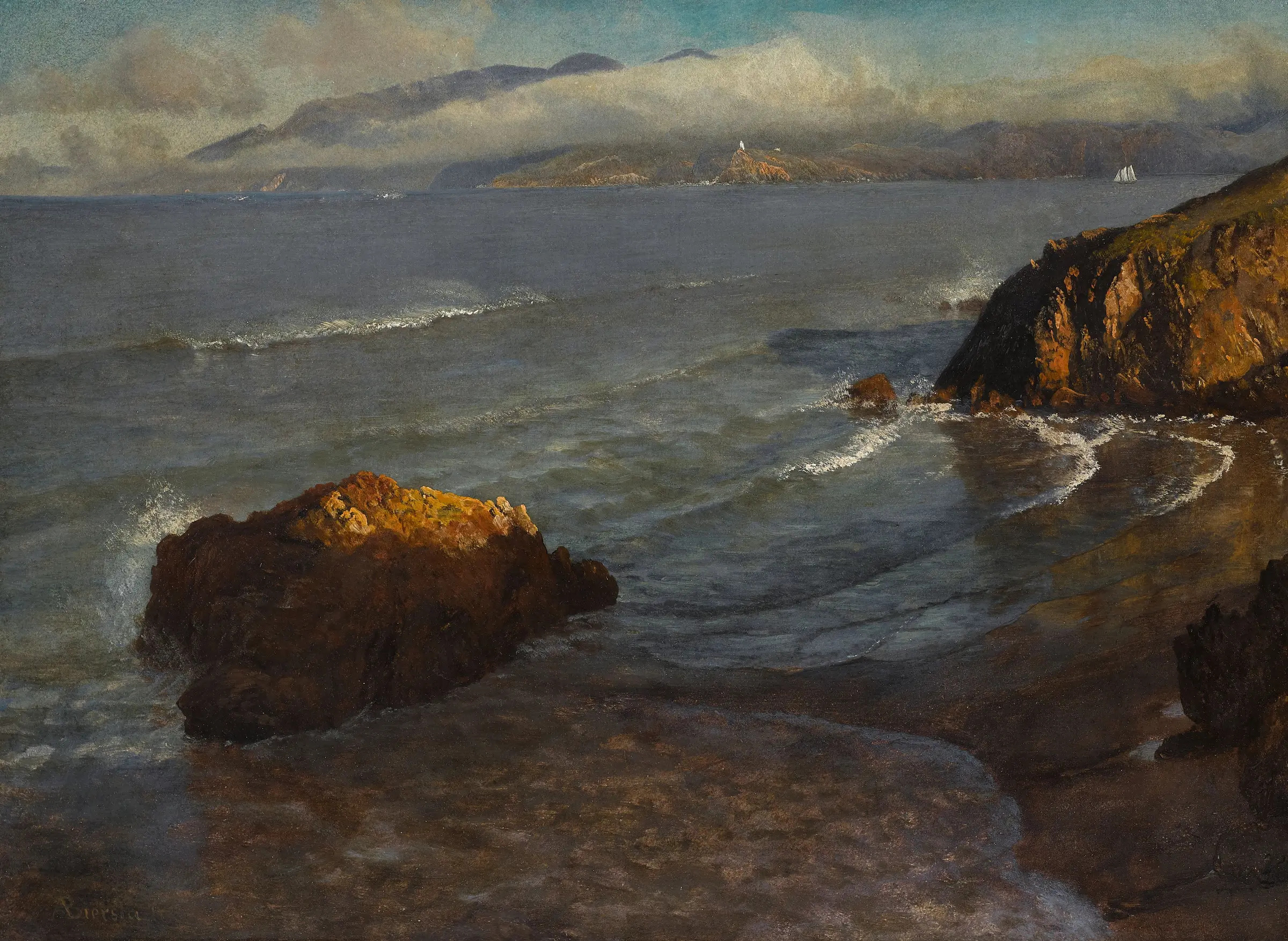
Image: Albert Bierstadt (1830–1902), Entrance to the Golden Gate, c. 1872.
Author: Susan McDonough
8 March 2026