19 October 2026
Shchukin was born in 1854 in Moscow to a wealthy family of Russian textile merchants. [90] He joined his father’s business I.V. Shchukin and Sons after studying the trade in France and Germany. [103] Shchukin excelled in the industry, earning himself the nickname “Minister of Commerce,” [165] and took over the enterprise when his father died in 1890. [175]
While Shchukin focused on business, several of his brothers began developing collections of art and antiquities. Petr was known as a voracious collector of antiquities, and he welcomed the public into his home to view his impressive acquisitions, which ranged from Russian artifacts to and exotic crafts from the Orient. [114] Dmitry was a patient yet passionate collector of Dutch classical painting. [140] And finally, Ivan, the youngest, favored the artistic and intellectual circles of Paris and hosted a high-profile weekly salon at his home. [158]
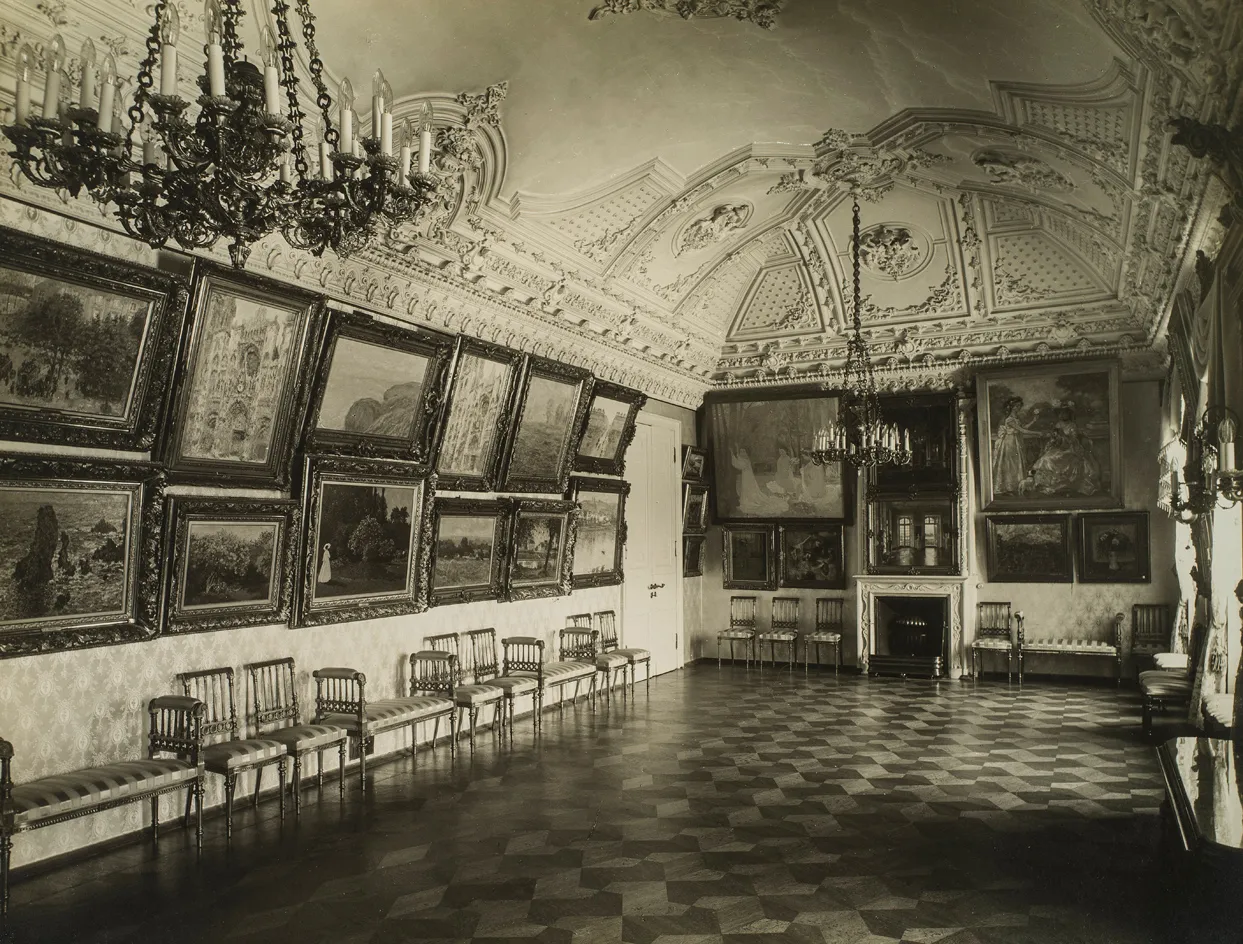
When Shchukin turned his attention to art, his collecting habits were characterized by the same critical acumen, ambition, and impulsive risk-taking that he brought to textile production. He began visiting the salons of Paris, and in 1898 stopped by Paul Durand-Ruel’s gallery in the Rue Laffitte. He was accompanied by his brother Pyotr, an ardent collector of mostly Russian antiquities, and their relative Fyodor Botkin, a painter who had relocated to Paris and was familiar with its dealers. [193] Each bought recent paintings by Camille Pissarro with Shchukin settling on “L’Avenue de l’Opéra, effet de Neige le Matin” (1898). He returned later that year to purchase his first work by Claude Monet, a piece from the series “Les Rochers de Belle-Île.” [194] More Monet canvases followed, including “Le Déjeuner sur l'herbe” and “Le Parlement de Londres, les Mouettes” (1903). [195]
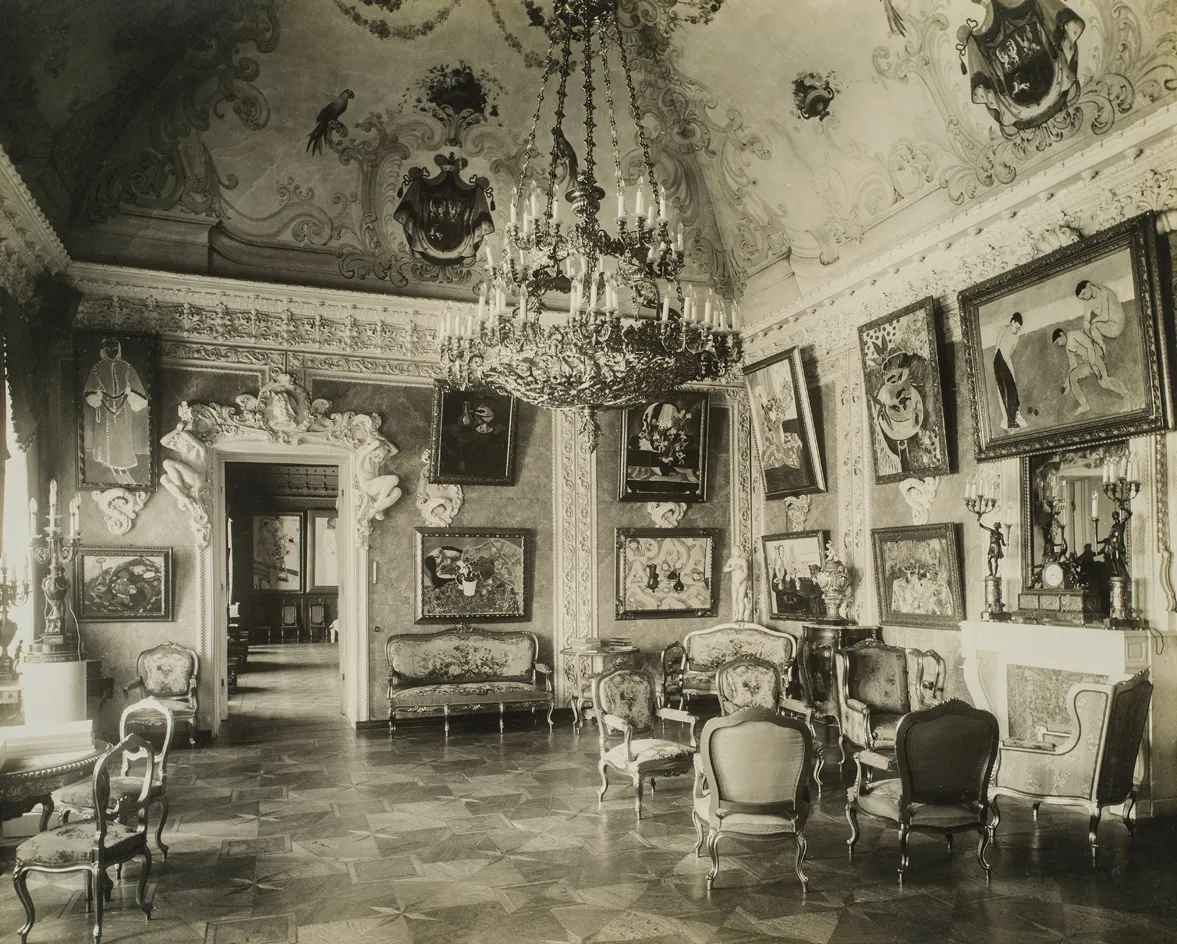
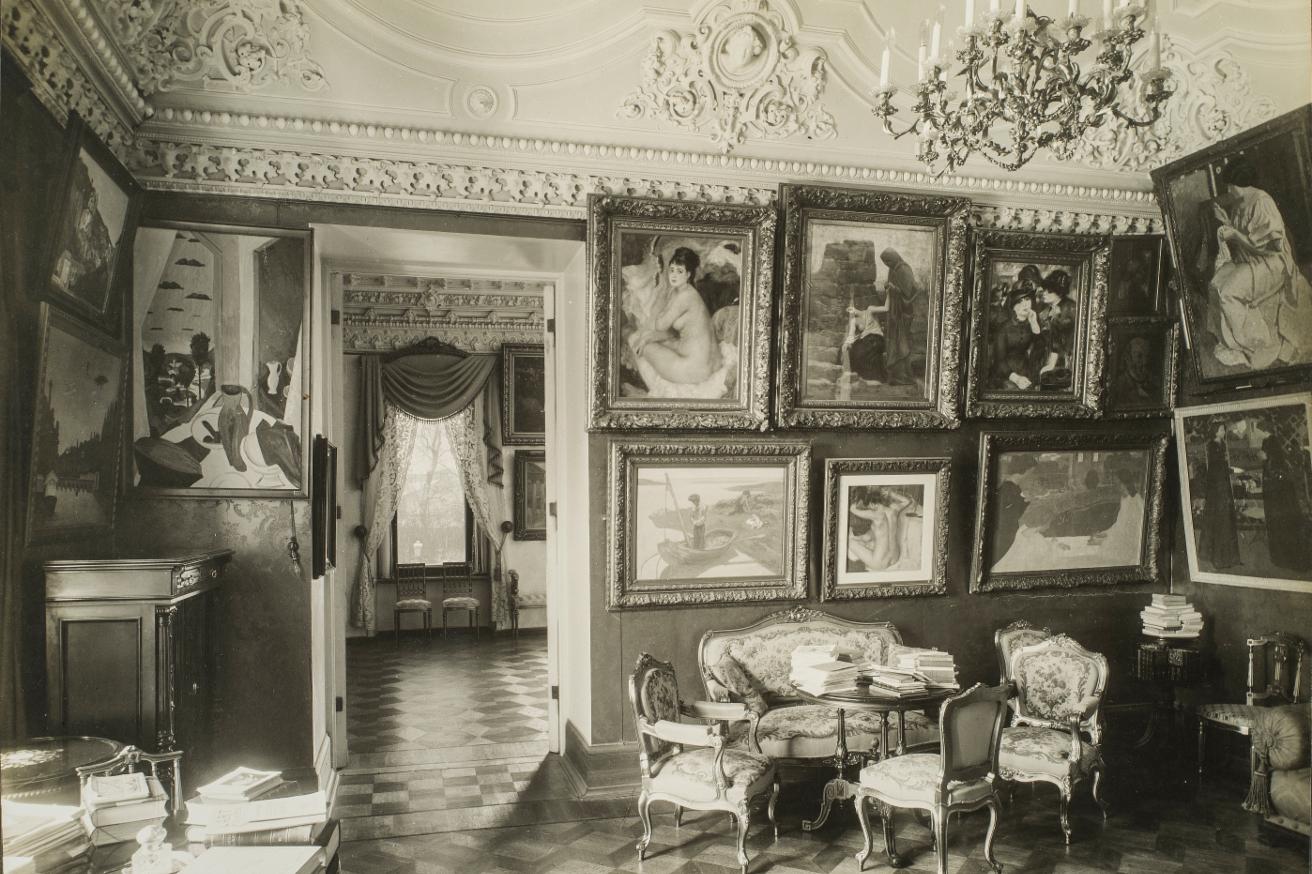
In 1903, he graduated to the post-Impressionists, and started buying Paul Cézanne, Vincent Van Gogh, and Paul Gauguin. By now, Shchukin and his young family were living in the Trubetskoy Palace, and he turned the sedate old-world interiors into a series of incongruous galleries for his growing art collection. In late 1905, in the wake of the disastrous Russo-Japanese War and the events of Bloody Sunday, the Shchukins’ teenage son disappeared – his body was found in the Moscow River months later. [238]
In January 1907, Shchukin’s wife, Lydia, died after a brief illness. In the immediate aftermath, Shchukin decided to bequeath his collection to the Tretyakov Gallery and began making plans to turn the home into a public art gallery. [257] He did not buy a single piece of art in 1907 and instead embarked on a trek across the Middle Eastern desert in a caravan of camels. [260] Despite sandstorms, swarms of insects, and oppressive heat, Shchukin sought peace.
Shchukin’s personal trials continued soon after returning to Europe. Ivan killed himself in the early days of 1908, led into debt by his extravagant lifestyle and an art collection mistakenly believed to be of dubious authenticity. [286] On the third anniversary of Lydia's death, another son killed himself. [346] But Shchukin strove to embrace the lessons and ecstatic beauty of the desert, and he turned his focus to his home, which was evolving into a museum of modern art. Schukin’s sensitivity to color and wanderlust had drawn him to Gauguin, and he bought his first pieces back in 1904. He hung them in his private office, hesitant to show anyone. Shchukin began hurriedly buying Gauguin in 1906, motivated by the positive reception of the artist’s retrospective at the Salon d’Automne. [252]
As his personal life darkened, Shchukin endeavored to brighten the palace’s sombre oak-panelled dining room by installing dozens of Gauguin’s Tahitian masterpieces. He paid extravagant prices for desired pieces, elevating the artist’s value along the way. [298] “The canvases hang side by side, touching, and at first you don’t see where one ends, and the other begins,” wrote critic Jakob Tugendhold. “You have the impression that you are standing before a fresco or an iconostasis.” [51] The assemblage bore a certain resemblance to the traditional wall of icons in Russian Orthodox churches, and it could be said that Shchukin’s collecting was a means of sublimating his deep personal grief. [295]
Perhaps Shchukin’s salon style was influenced by Gertrude Stein. He had likely visited the writer’s Parisian home to view Henri Matisse’s “Le Bonheur de Vivre,” which Stein and her brother, Leo, had purchased at the Salon des Indépendants in March 1906. (The previous year, they’d bought the similarly controversial “La Femme Au Chapeau.”) Shchukin had been deeply struck by “Le Bonheur de Vivre.” He felt chosen by the painting, but he could not have it. [242]
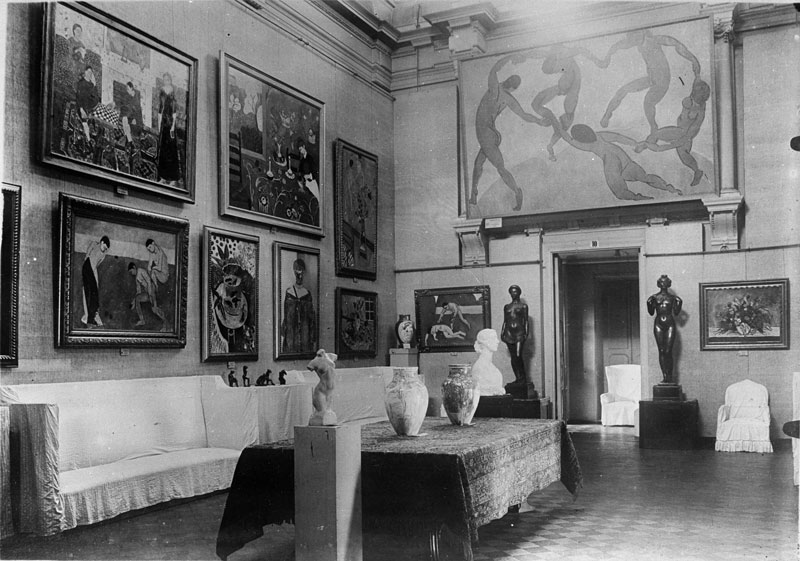
He surprised dealer Ambroise Vollard by requesting a meeting with Matisse—socializing with artists was not normally a part of Shchukin’s purchasing routine. [243] During a visit to Matisse’s fifth-floor studio on Quai St.-Michel in May, he picked up a drawing and two lithographs. [247] His patronage of Matisse began in earnest in 1908 with a shopping spree and a major commission. He intended to counterpoint the warm Gauguins with a panel colored by a sea of blues. [315] Months later, when the painting arrived in Moscow, the domestic scene had been rendered in red and was dubbed “La Desserte, Harmonie en rouge” (1908). [321]
Shchukin seemingly felt no ill will and commissioned the artist again. At first, he was taken aback by the artist’s initial sketches for the pair of enormous panels for the main staircase in the Trubetskoy Palace, writing, “I cannot hang nudes in my staircase.” But he overcame his reservations, writing in a telegram to Matisse, “I find your panel ‘La Dance’ to be of such nobility that I have resolved to defy Russian bourgeois opinion.” [44] In 1911, when Matisse visited Moscow to install the panels, he also supervised the hanging of his works in the palace’s pink salon, where their bright colours would harmonize with the pale green walls, pink ceiling, and crimson carpet. [403]
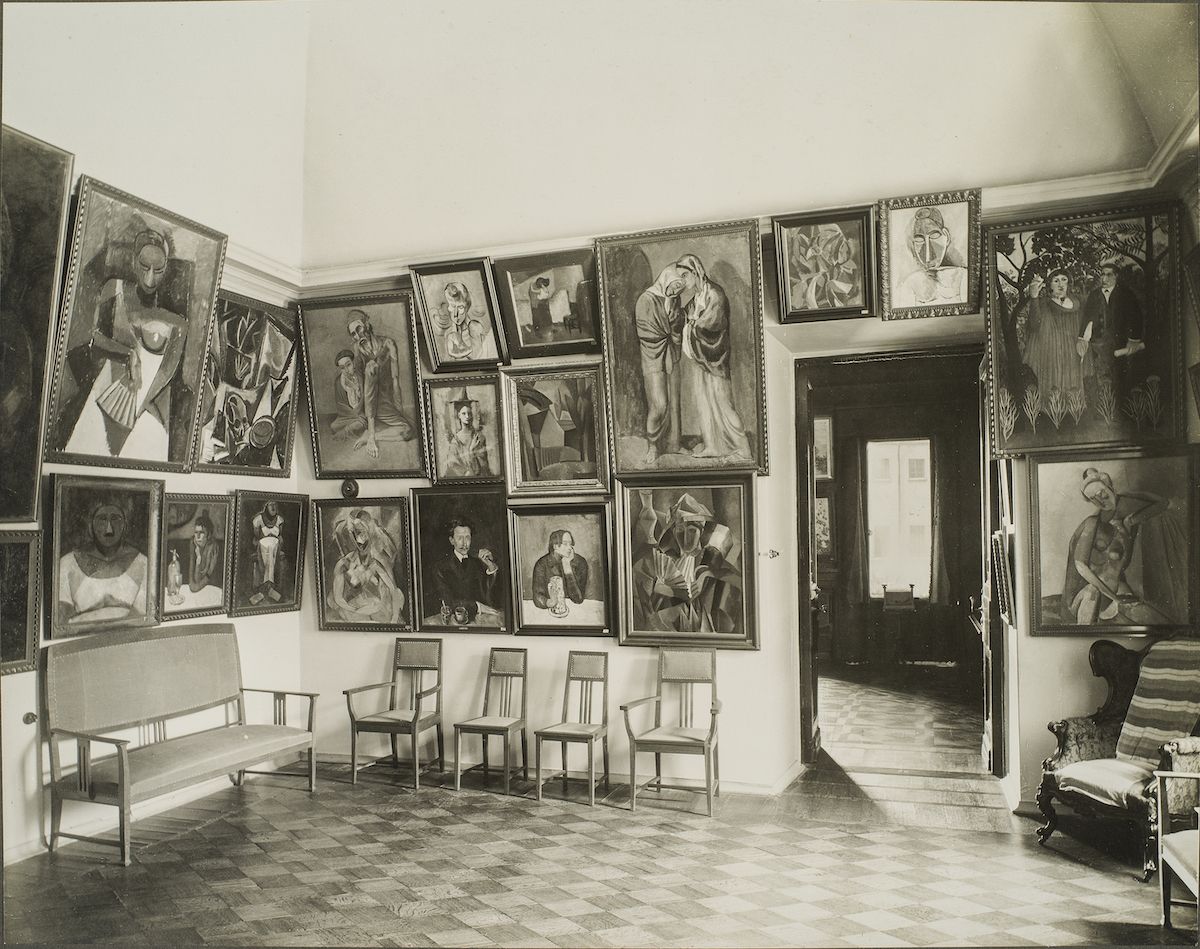
It was Matisse who brought Shchukin to Montmartre to meet Pablo Picasso in 1908. [412] Shchukin was cautious, only becoming a devout collector several years later. By 1914, Shchukin had devoted a room to his Picasso collection, which numbered no fewer than 50. [421] Shchukin had by this time already started opening the Palace to the public, and the impact on the Russian avant-garde was profound. Shchukin personally gave tours of his collection and was known to passionately defend Picasso from detractors. [426] The palace soon became a gathering place where Russian avant-garde artists could absorb developments in modern art without traveling to Paris. [438]
Shchukin married for the second time just before the outbreak of war, and in 1918 he secretly left Bolshevik Russia, eventually settling with his wife and their young daughter in Paris. His collection stayed behind and was quickly nationalized by the government. [480] Trubetskoy Palace opened to the public as the Museum of Modern Western Painting No. 1 in 1920. [484] Two years later it was administratively merged with the larger collection of Shchukin’s fellow merchant patron Ivan Morozov and that of Morozov’s deceased elder brother Mikhail. [488] Known as the State Museum of New Western Art, the collections were later unified under one roof, only to be dismantled soon after. [490] In the harsh anti-cosmopolitan climate at the conclusion of the Second World War, Stalin ordered that the Shchukin and Morozov collections be divided, landing at the Hermitage and Pushkin Museums [497]. It was only after Stalin’s death that some of the paintings began to be displayed again, at long last.
1
Semenova, Natalya, and André Delocque. The Collector: The Story of Sergei Shchukin and His Lost Masterpieces. Translated by Anthony Roberts, Yale University Press, 2018.
Image: Top: “Woman With a Fan” (1907); “Still Life. Composition with a Skull” (1908); “Old Jewish Man with a Boy” (1903); “Man with Folded Arms” (1909); “Spanish Woman from Mallorca” (1905); “Date (Embrace)” (1900); “House in the Garden (House and Trees)” (1908-09); “Two Sisters (The Meeting)” (1902) ; “Three Women (study)” (1907-08); “Nude Woman. Bust” (1907); Henri Rousseau, “The Muse Inspiring the Poet (Poet and Muse)” (1908-09)
Bottom: “Farm Woman (bust)” (1908); “Femme Au Cafe/Absinthe Drinker” (1901-02); “Farm Woman (full-length)” (1908); “Young Lady” (1909); ”Portrait of Benet Soler” (1903); “Portrait of the Poet Sabartes (Glass of Beer)” 1901; “Lady with a Fan” (1909); “Naked Woman” (1909)
19 October 2026