Valuing Art: Methodology Across Market, Museum, and Scholarship
Thoughts: Tobias Czudej01.06.2026
Greatly enjoyed giving this lecture yesterday at The University of Hong Kong. Thank you Alessandra Cianchetta for inviting me as part of your Global Artscapes seminar.
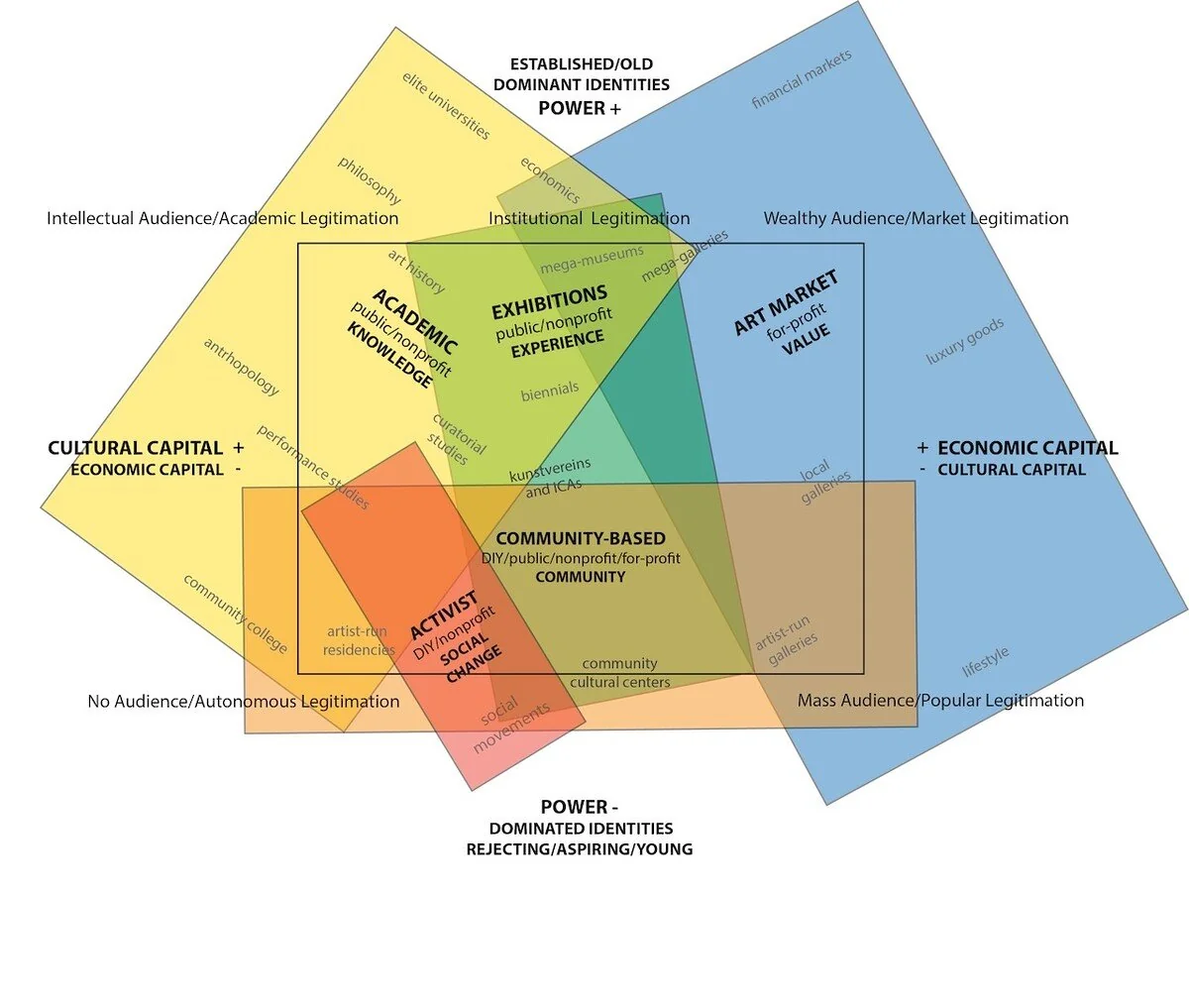
The talk addressed a question that shapes our daily practice as appraisers: how does art acquire value across three distinct but interconnected spheres - commercial market, museum exhibition, and academic scholarship? Andrea Fraser's diagram of the contemporary art field provided a useful framework for visualizing these overlapping subfields, each with their own legitimation systems and value criteria. The appraiser's work lies in translating between them, converting institutional validation into market confidence, scholarly recognition into collector demand, cultural capital into economic value.
The Kerry James Marshall data makes this concrete. Tracking his career over 25 years, we observe how institutional validation in one field converts to market performance in another, from his 1997 MacArthur Grant through his 2016-2017 touring retrospective (The Met, MOCA, MCA) to his 2018 auction record. Yet correlation demands careful interpretation. His upcoming 2025-2027 Royal Academy retrospective will test whether these translation mechanisms continue to function as new dynamics and patterns are emerging.
For collectors and those that serve them, understanding these cross-field mechanisms matters practically. A painting is an asset but its value operates through cultural systems that resist standard valuation models. The appraiser's challenge lies in weighing evidence from all three domains - quantifiable data alongside artist-specific factors and market-specific dynamics that exist only through relationship-dependent intelligence - whilst maintaining analytical objectivity about how these mechanisms actually function